Blog

  • Sounding out New Lexical Space

    It is well known that ESL Chinese students often struggle with singular and plural nouns. Of course, their struggles expose a patchwork system of rules and exceptions we have in English; this is where countable and uncountable nouns live, some of which can be either in different contexts or when used in a different sense. In this post, I will cover some of the more uncanny lexical spaces that adding an “s” can occupy. Hopefully, there is something for both native and non-native speakers to take away.

    Adding an “s” to a mass, or uncountable, noun can signal part of speech to the informed reader, while non-native students may misread or need more time to come to such a conclusion. Consider the case of “police.” Knowing that police is a collective noun and therefore almost never takes “s” (see fishes below) causes me to immediately interpret the word “polices” as a verb, regardless of location in the sentence. Thus, the value of the “s” can be said to increase clarity not along the singular–plural dimension, but along the noun–verb dimension.

    It seems that learners would benefit more from learning some of these edge cases through “chunking” rather than by applying rules. Take “take note” versus “take notes,” for example. These occupy distinct lexical spaces (“notice” and “write down a synthesis of what is being said,” respectively) despite at first glance to the non-native being a simple addition of an “s” to make a plural.

    A word that can make Chinese students pull their hair out is just that: hair. Even a native speaker is hard-pressed to explain when it should be pluralized and why a clump of hair is not a clump of hairs. Again, it comes back to lexical nuance: when we want to emphasize one meaning or another, we flip the countable/uncountable switch, and voilà, something has “the width of three hairs” instead of “the width of a lock of hair.” The singular–plural model is not robust enough to explain these semantics.

    Even “fishes” and similar words, like “peoples,” vacuum up lexical space as stand-ins for “different kinds of fish” and, say, “distinct ethic groups.” You’ll also see alternative forms used for poetic levity or euphony, as in the phrase “if fishes were wishes, . . .”

    In my experience, translators from Chinese to English are prone to misinterpreting or misusing these and other use cases for the “s” outside of pluralization. In some cases, it is even by political fiat that these changes are made, as in the switch from “these United States” to “the United States,” a change from plural to singular without the dropping of an “s.” Sneaky, yet effective. However, this example dips into an equally deep yet different pool of quicksand for the non-native speaker: articles. But they deserve their own article.
  • Translation Ethics and Choice

    Translation Ethics by Joseph Lambert was a well-written introduction to the sub-field that posed many questions while leaving the reader free to come up with his or her own answers. Of course, this left me plenty of time to mull over the different paths that could be taken in its various case studies (a few of which I will discuss here), and it also left me slightly peeved at the hesitancy of the modern author to take any firm stance on any issue—though I fully understand it. This is a short review of several tiny parts of the book that are on my mind at the moment. I shall come back to other parts in future posts.

    Once one accepts that direct word-for-word translation is not optimal in 100% of cases—let’s say, “red dust” for the Chinese “红尘” (红 = red, 尘 = dust), a word which means the world of mortals (as opposed to the world of deities), the translator is opened up to a world that is, on one hand, quite a fun and creative endeavor. This perhaps explains why some people want to be translators; it’s much more than just copy-pasting word by word from a dictionary, to put it very crudely. On the other hand, the book states that translators may be grappling with a long list of considerations: personal interest, competing ideologies, power dynamics, moral relativism, xenophobia, and the list goes on. I have seen situations where a translator is forced to choose a side because every word, for better or for worse, is laced with connotation; or better yet, if it is neutral, then the adage “silence speaks louder than words” can be applied directly to neutral writing. To use a few scapegoats that won’t get me in trouble, consider the reaction of Americans to calling North Korea’s state mouthpieces “independent news outlets,” or Kim Jung-Un a “duly-elected leader,” simply because that is how these terms might be written in Korean (I don’t know Korean; this is merely a fictional and exaggerated example).

    Surprisingly, that is basically what I do in my translating, though not all translators may have the same luxury. I think the translator has a basic veto right; that is, as one of many translators out there (i.e., not a monopoly providing a basic necessity), he or she has the right to refuse service to any client, for any reason, but particularly for reasons of ideology. Perhaps a translator may still take a client whose works go against their beliefs, and try to be neutral and invisible, but perhaps they ought to also let a client know if they have any biases that could impact the finished product, and let the client decide if the translator should be recused. One example from the book that stood out to me was a German translator translating a Finnish author’s novel to German. The protagonist of the novel had a very unfortunate birthday: April 20th, the same day as Hitler. What happened in practice was that the translator unilaterally decided to change the birthday to April 19th to avoid the novel being taken for Neo-Nazi Propaganda, choosing to not contact the author for fear of being disallowed the change. Recently, online, I have seen other cases brought forward by members of Japanese anime communities lamenting more heavy-handed changes made by localizers trying to scrub lines that are, to them, supporting “the patriarchy.” Different translators will feel that the line that shall not be crossed is in different places, and different readers want different levels of strict translation or ignorant bliss.

    I find it is much easier to ascribe nearly unlimited intelligence to the reader, and simply let the chips fall where they may. In cases of extreme discomfort, I come down on the side of the translator’s veto. If I’m uncomfortable working with the material, I won’t promise the client transparency while “saving the world” in the background. I may make suggestions on changes, which authors can sometimes be amenable to, and I may choose to not work on a specific project. It is true that certain viewpoints will be shared more by me as a result of this; no man is an island. I believe it’s better to respect the client and the work by talking upfront than to go behind their back and make stealth edits to appease my own sense of justice, morality, or what have you. I hope other translators do the same in order to lend more respect to our industry.

  • “Take-ism” by Lu Xun

    Translated by Nathan J. Stoltzfus, June 2025

    Translator’s note: Lu Xun was the pen name of Zhou Shuren, an early 20th century Chinese thinker and writer whose works were notably irreverent and satirical, yet are still read in schools to this day.

    China was, in recent times, “isolationist”—we did not go, and others needed not come. From the time we let the cannons bust down the front door—and then walked into a strip of nails—until now, everything has been about “Send-ism.” To ignore other things for now and speak only of the skilled arts: Recently, a collection of antiques was sent to Paris for exhibition, but, in the end, “the results were unknown.” Several “masters” also there were; they cradled several paintings, both new and ancient, and hung them in every European country along their way; it was called “Forwarding the Nation’s Luster.” I’ve heard that Dr. Mei Lanfang will soon be sent to the Soviet Union to press for Symbolism, afterwards swinging by Europe to proselytize. I don’t want to discuss the connection between Dr. Mei’s acting and Symbolism here; in brief, live people replacing antiques can, I daresay, be considered as showing a step in the right direction.

    But we haven’t anyone saying in accord with the etiquette of “courtesy demands reciprocity,” “Take!”

    Of course, if all that can be done is Send, this cannot be considered evil; it appears plentiful to one and magnanimous to the other. Nietzche himself bragged that he was a sun having inexhaustible light and warmth, only giving and never wanting to take. But when Nietzche became exhausted and was not, in fact, a sun, he went crazy. China is also not a sun; though there are people who say digging up the coal underneath the ground is enough for the entire world to use for hundreds of years, what about after those hundreds of years? After several hundred years, we will, of course, have been reduced to souls, or ascended to heaven, or descended to hell, but our descendants will be here, so we yet ought to leave behind some gifts. If not, then on festivals and ceremonies, they’ll have nothing to proffer, being only able to kowtow and offer congratulations, and to beg for some leftover scraps as their reward. Don’t mistake this kind of reward as “thrown with,” for it is “thrown to”; said in a statelier manner, it might be called Given. I don’t want to provide real-life examples here.

    I do not want to say any more on Sending here; it would be too “un-modern.” I want only to drum up our miserliness; apart from Sending, we also have to Take, that is: Take-ism.

    But the things we have been Sent are frightening. First was England’s opium and Germany’s rubbish firearms, then France’s face powder, America’s movies, and Japan’s collection of little things all imprinted with “Wholly Domestic [Chinese] Product.” Hence, even clear-headed young people feel terrified towards foreign goods. In reality, this is exactly for the reason that those things are Given and not Taken.

    Thus, we need to use our brains, open our eyes, and come Take for ourselves!

    For instance, a poor youth among us who, because of the good deeds of his forebears (allow me to say it in this way for the moment) received a large house, and at the time did not ask if it was inherited by scheme, theft, or by legal means, or whether it was an exchange for his becoming a son-in-law. So, then, what should be done? I believe it is not to squabble over trivialities, but to Take! Though, if he opposes the previous owner of the house, is afraid it will get his things dirty, and dithers on the doorstep, he is a weakling. He who flies into a rage and sets a fire to burn it clean, counting it as a keeping his purity, is a fool. But if, because he was originally an admirer of the house’s owner, he accepts it all, happily limping into the bedroom and inhaling deeply the remaining opium, he is, of course, even more worthless. Takers would do none of these things.

    He possesses choice. Seeing shark’s fin, he would certainly not throw it onto the street to manifest “democratization”; as long as it’s got nutrients, he’d eat it with friends just as he eats carrots and cabbage, though he’d not use it to feed esteemed guests. Seeing opium, he would not pitch it into the latrine for all to see, but, seeing this, would revolutionize it, only giving it to the pharmacies for use in treating the sick, and would not ply such deceits as “Selling shelf-stable creams! We’re almost out of stock!” It is only those opium pipes and lamps, though not in the same shape as opium paraphernalia from India, Persia, or Arabia, that can still be considered an essence of Chinese culture; in the event that these were carried around the world, there would certainly be people who’d look at them, but I think, excepting a few for the museums, the others should largely be destroyed. Also, there’s a group of concubines—I strongly believe it right to ask them to disperse of their own accord; otherwise, I worry Take-ism would be not without a little danger.

    In short, we need to Take. We need to either use, store, or destroy. In this way, the owner will be the new owner, and the house shall become a new house. Furthermore, this person will first need composure, fierce bravery, a discriminating eye, and unselfishness. Have they not Taken, they cannot themselves become new people; have they not Taken, the arts cannot themselves become new arts.

    June 4th.

  • What is poetry translation?

    There are many who translate poetry today, yet they vary greatly in their translation styles, and the results are perhaps even more variegated than the translators, even for the same poems. A cynic might say that these people are looking to stand out, to make their mark, and if they have to run roughshod all over the original, it doesn’t matter. I prefer to think that they are simply coming from different places and hold different opinions or beliefs on translation. Of course, a part of the differences may be up to translator error. So, what constitutes an error, what constitutes a conscious choice, and what is a poetry translation?

    Arthur Schopenhauer famously said that “Poetry cannot be translated.” In fact, many have shared his view over the years. If economics is the dismal science, then poetry translation may well be the downright pessimistic science. In my own experience, he is largely correct; poetry can perhaps never be rendered perfectly in another language. When I get close, it feels like part luck and part skill. For instance, a rhyme that just happens to exist in English, and I found it. Still, rhymes are only one layer to the onion. Vladimir Nobokov wanted “copious footnotes,” and not the “emasculation and padding” of “. . . poetical versions, begrimed and beslimed by rhyme.” I agree with and share this want for myself, but it may not be a method that works for all audiences. Some audiences read poetry to study history, some read it to study the author, some read it to feel something, and some read it to dream. The real question is whether the kinds of poetry tailored to these audiences should all be considered translations, or whether some of them are, well, other things. Transcreations, adaptations, localizations—take your pick.

    I come down on the side of fire and brimstone. Conservatism in defining translation. Just like a biblical translator would, I take the original document as the word of God. The best policy when you want to change something is to consult the author. Barring that, no can do. Any activities like paying attention to cultural sensitivity, adding in new content to make rhymes that snap, etc., are, to me, outside the scope of translation (though perhaps ultimately useful and necessary to a particular client).

    A natural corollary to this is that translations should be nearly one-to-one. That is, there ought to be some quantifiable and acceptable band of liberty a translator can take, outside which the text can no longer be considered a translation, strictly speaking. And translators should be tasked with self-reporting if their work is a translation or another endeavor. After all, there is nothing stopping translators from writing their own stories. Be creative as you will. Just not on the page that is supposed to contain the words, thoughts, and stories of another author, merely transposed into another language. Put that way, it seems that translators taking excessive liberties could be diagnosed with “main character syndrome” (read: excessive self-importance).

  • The Han Suyin International Translation Competition

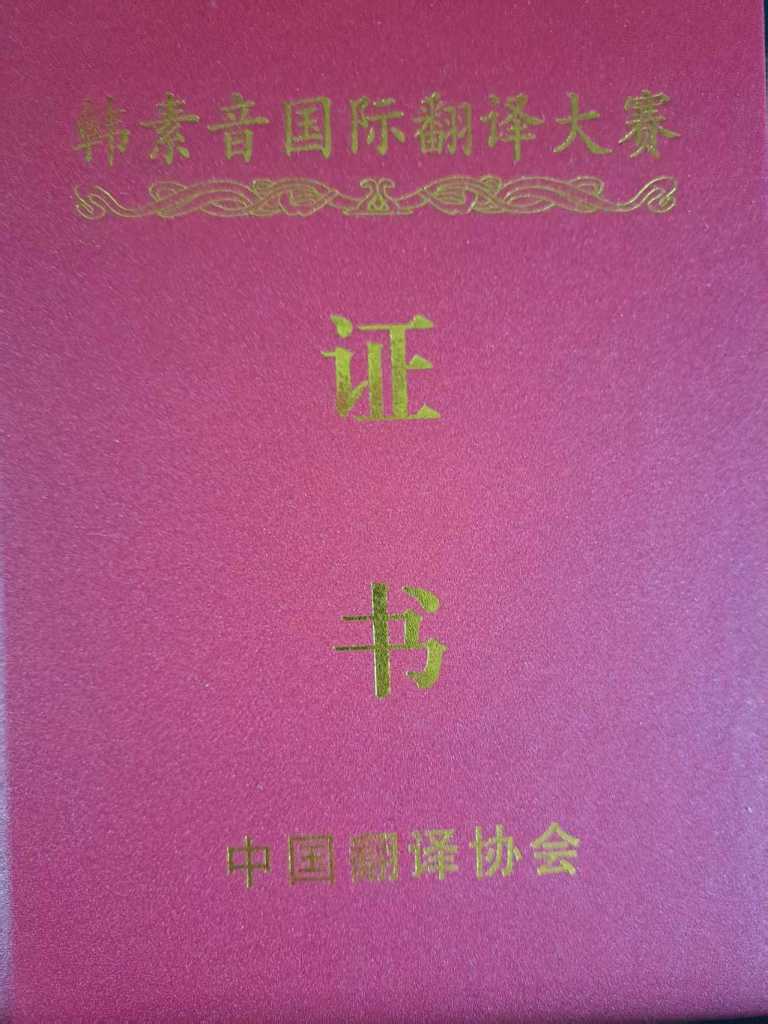
    The 2022 Han Suyin International Translation Competition (韩素音国际翻译大赛) was my beginning in translation. I was encouraged to participate by a friend in China, and it was tough going at the time. Luckily, the competition took place over five months, and participants had simply to submit their translated text before the deadline.

    I was enamored with researching and trying to find the best English mapping for the text. Smitten, really. With my poor level of ability at the time, it took around 40 hours to produce seven drafts for three pages of text. The writing mechanics of the piece were excellent, and it was interesting to translate. The topic was China’s ICH, or Intangible Cultural Heritage, and I learned many new things while translating. Perhaps this is what I like about translation. I get paid to learn, explore, discover, and leave my own meaningful mark.

    As an aside, I do have a disdain for the UNESCO term “Intangible Cultural Heritage,” or at least how it’s used in China. It’s supposed to be used for intangible things, right? Things that cannot be touched, like, say, a method of dance or a system of language. But I can walk down a food street in China and see many vendors selling “ICH Fried Duck,” “ICH thousand-layer flatcakes,” “ICH dumplings,” etc. As people often remind me, it is the method of cooking that is intangible, not the foods themselves. However, I shake my curmudgeonly fist at that, yes I do. It’s overused and abused to the point that it’s becoming meaningless. Soon, a vendor selling ramen noodles on the street will call it ICH when he immerses them in boiling water, strains them, and adds the flavor packets. It’s laughable. Anyway, back to the translation competition.

    So, I had a rough go of it, but I managed to win an Excellent Translation Award. About three percent of the 30,000+ submissions that year earned awards, and in the Chinese to English category, no one got first place, 10 got second place, 22 got third place, and 188 got the Excellent Translation Award. Needless to say, I was very happy with the result, because anyone participating in the competition had to be at least somewhat serious. The result showed me that I had a talent for translation, though I will admit it’s an advantage to be a native English speaker in the Chinese to English category. Perhaps more on that in another blog post. Still, there are not many native English speakers who know enough Chinese to do better.

    Since 2022, I have participated each successive year, but have not managed to earn any more awards. We’ll see what 2025 brings! The submissions are due before June 1st, 2025.

    P.S. For the C -> E category, I really wish they would let us add footnotes or, barring that, at least italicize words if we want to (there are many reasons to italicize in translations).