Tag: writing

  • Sounding out New Lexical Space

    It is well known that ESL Chinese students often struggle with singular and plural nouns. Of course, their struggles expose a patchwork system of rules and exceptions we have in English; this is where countable and uncountable nouns live, some of which can be either in different contexts or when used in a different sense. In this post, I will cover some of the more uncanny lexical spaces that adding an “s” can occupy. Hopefully, there is something for both native and non-native speakers to take away.

    Adding an “s” to a mass, or uncountable, noun can signal part of speech to the informed reader, while non-native students may misread or need more time to come to such a conclusion. Consider the case of “police.” Knowing that police is a collective noun and therefore almost never takes “s” (see fishes below) causes me to immediately interpret the word “polices” as a verb, regardless of location in the sentence. Thus, the value of the “s” can be said to increase clarity not along the singular–plural dimension, but along the noun–verb dimension.

    It seems that learners would benefit more from learning some of these edge cases through “chunking” rather than by applying rules. Take “take note” versus “take notes,” for example. These occupy distinct lexical spaces (“notice” and “write down a synthesis of what is being said,” respectively) despite at first glance to the non-native being a simple addition of an “s” to make a plural.

    A word that can make Chinese students pull their hair out is just that: hair. Even a native speaker is hard-pressed to explain when it should be pluralized and why a clump of hair is not a clump of hairs. Again, it comes back to lexical nuance: when we want to emphasize one meaning or another, we flip the countable/uncountable switch, and voilà, something has “the width of three hairs” instead of “the width of a lock of hair.” The singular–plural model is not robust enough to explain these semantics.

    Even “fishes” and similar words, like “peoples,” vacuum up lexical space as stand-ins for “different kinds of fish” and, say, “distinct ethic groups.” You’ll also see alternative forms used for poetic levity or euphony, as in the phrase “if fishes were wishes, . . .”

    In my experience, translators from Chinese to English are prone to misinterpreting or misusing these and other use cases for the “s” outside of pluralization. In some cases, it is even by political fiat that these changes are made, as in the switch from “these United States” to “the United States,” a change from plural to singular without the dropping of an “s.” Sneaky, yet effective. However, this example dips into an equally deep yet different pool of quicksand for the non-native speaker: articles. But they deserve their own article.
  • What is poetry translation?

    There are many who translate poetry today, yet they vary greatly in their translation styles, and the results are perhaps even more variegated than the translators, even for the same poems. A cynic might say that these people are looking to stand out, to make their mark, and if they have to run roughshod all over the original, it doesn’t matter. I prefer to think that they are simply coming from different places and hold different opinions or beliefs on translation. Of course, a part of the differences may be up to translator error. So, what constitutes an error, what constitutes a conscious choice, and what is a poetry translation?

    Arthur Schopenhauer famously said that “Poetry cannot be translated.” In fact, many have shared his view over the years. If economics is the dismal science, then poetry translation may well be the downright pessimistic science. In my own experience, he is largely correct; poetry can perhaps never be rendered perfectly in another language. When I get close, it feels like part luck and part skill. For instance, a rhyme that just happens to exist in English, and I found it. Still, rhymes are only one layer to the onion. Vladimir Nobokov wanted “copious footnotes,” and not the “emasculation and padding” of “. . . poetical versions, begrimed and beslimed by rhyme.” I agree with and share this want for myself, but it may not be a method that works for all audiences. Some audiences read poetry to study history, some read it to study the author, some read it to feel something, and some read it to dream. The real question is whether the kinds of poetry tailored to these audiences should all be considered translations, or whether some of them are, well, other things. Transcreations, adaptations, localizations—take your pick.

    I come down on the side of fire and brimstone. Conservatism in defining translation. Just like a biblical translator would, I take the original document as the word of God. The best policy when you want to change something is to consult the author. Barring that, no can do. Any activities like paying attention to cultural sensitivity, adding in new content to make rhymes that snap, etc., are, to me, outside the scope of translation (though perhaps ultimately useful and necessary to a particular client).

    A natural corollary to this is that translations should be nearly one-to-one. That is, there ought to be some quantifiable and acceptable band of liberty a translator can take, outside which the text can no longer be considered a translation, strictly speaking. And translators should be tasked with self-reporting if their work is a translation or another endeavor. After all, there is nothing stopping translators from writing their own stories. Be creative as you will. Just not on the page that is supposed to contain the words, thoughts, and stories of another author, merely transposed into another language. Put that way, it seems that translators taking excessive liberties could be diagnosed with “main character syndrome” (read: excessive self-importance).

  • The Han Suyin International Translation Competition

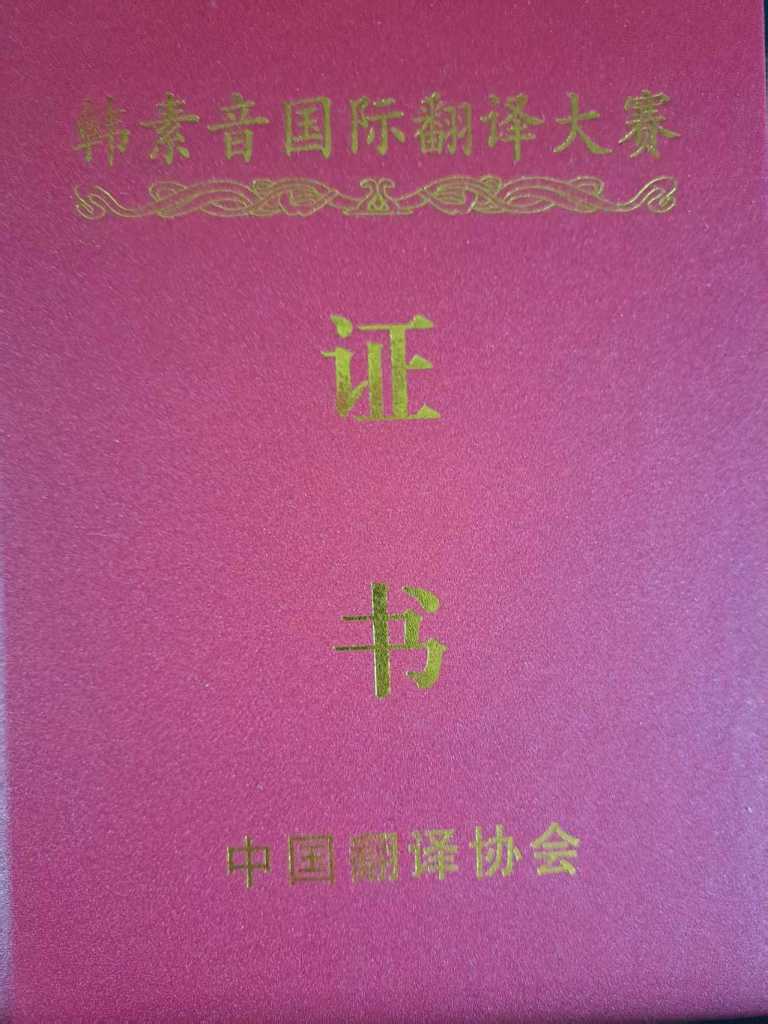
    The 2022 Han Suyin International Translation Competition (韩素音国际翻译大赛) was my beginning in translation. I was encouraged to participate by a friend in China, and it was tough going at the time. Luckily, the competition took place over five months, and participants had simply to submit their translated text before the deadline.

    I was enamored with researching and trying to find the best English mapping for the text. Smitten, really. With my poor level of ability at the time, it took around 40 hours to produce seven drafts for three pages of text. The writing mechanics of the piece were excellent, and it was interesting to translate. The topic was China’s ICH, or Intangible Cultural Heritage, and I learned many new things while translating. Perhaps this is what I like about translation. I get paid to learn, explore, discover, and leave my own meaningful mark.

    As an aside, I do have a disdain for the UNESCO term “Intangible Cultural Heritage,” or at least how it’s used in China. It’s supposed to be used for intangible things, right? Things that cannot be touched, like, say, a method of dance or a system of language. But I can walk down a food street in China and see many vendors selling “ICH Fried Duck,” “ICH thousand-layer flatcakes,” “ICH dumplings,” etc. As people often remind me, it is the method of cooking that is intangible, not the foods themselves. However, I shake my curmudgeonly fist at that, yes I do. It’s overused and abused to the point that it’s becoming meaningless. Soon, a vendor selling ramen noodles on the street will call it ICH when he immerses them in boiling water, strains them, and adds the flavor packets. It’s laughable. Anyway, back to the translation competition.

    So, I had a rough go of it, but I managed to win an Excellent Translation Award. About three percent of the 30,000+ submissions that year earned awards, and in the Chinese to English category, no one got first place, 10 got second place, 22 got third place, and 188 got the Excellent Translation Award. Needless to say, I was very happy with the result, because anyone participating in the competition had to be at least somewhat serious. The result showed me that I had a talent for translation, though I will admit it’s an advantage to be a native English speaker in the Chinese to English category. Perhaps more on that in another blog post. Still, there are not many native English speakers who know enough Chinese to do better.

    Since 2022, I have participated each successive year, but have not managed to earn any more awards. We’ll see what 2025 brings! The submissions are due before June 1st, 2025.

    P.S. For the C -> E category, I really wish they would let us add footnotes or, barring that, at least italicize words if we want to (there are many reasons to italicize in translations).